






In the high-stakes world of enterprise technology, almost every executive team eventually rallies around a familiar corporate battle cry: “We need to become a data-driven organization.”
It’s an admirable goal. When you look at the companies dominating their respective industries, they all seem to possess a near-prophetic ability to predict market shifts, optimize logistics, and understand their customers down to the pixel. Naturally, leadership assumes that if they can just gather enough data and put it in front of their teams, they will unlock the same competitive advantage.
So, the investments begin. The enterprise purchases cutting-edge analytics software, hires data engineering talent, and launches massive initiatives to clean up legacy data repositories. Yet, fast-forward six to twelve months, and a frustratingly common pattern emerges. Despite the new tools and the expensive cleanup projects, the exact same issues begin to creep back into the system. Executive dashboards display conflicting metrics. The sales team complains that customer contact information is riddled with duplicates. Accounting spends days manually reconciling financial reports before they can close the books.
What went wrong? The breakdown rarely stems from a lack of budget, effort, or talent. Instead, it almost always points to a fundamental misunderstanding of two distinct, yet deeply codependent disciplines: Data Quality and Data Governance.
In many corporate circles, these two terms are thrown around as if they mean the exact same thing. That confusion is a costly mistake. Treating data quality and data governance as interchangeable is like confusing the health of a physical product with the entire design, safety, and manufacturing blueprint of the factory that built it. If you focus on one while ignoring the other, your enterprise data asset will eventually fail.
1. Defining the Roles: The State vs. The Framework
To build an infrastructure where data can actually be trusted to drive million-dollar decisions, we have to clearly separate the tactical execution from the strategic rules. Let’s look at each discipline on its own terms.
Data Quality (The State of the Asset)
Data Quality is an operational, highly technical measure of the data’s condition. It answers a very straightforward, immediate question: Is this data accurate, complete, consistent, and fit for its intended purpose right now?
Data Quality is all about the data itself. If you are looking at a row in a SQL Server database containing customer records, data quality ensures that the phone number field contains actual digits, the email address includes an @ symbol, the zip code matches the state, and the spelling of the customer’s name is accurate.
The toolset of data quality is highly technical. It relies on automated scripts, data profiling software, parsing APIs, deduplication algorithms, and standardization routines. It is a snapshot of health. If your data is clean, valid, and well-formatted today, you have high data quality today.
Data Governance (The Strategic Blueprint)
Data Governance, on the other hand, has very little to do with writing code or parsing strings. It is an organizational framework made of strategy, policy, culture, and accountability. It answers the structural questions: Who owns this data? Who has permission to change it? What are our corporate standards for data privacy and security? What happens when a data rule is broken, and who is responsible for fixing it?
If Data Quality is about the data, Data Governance is about the people and processes that interact with that data.
Governance is what defines the data lifecycle from the moment a record is created by a customer on a web form to the moment it is archived or deleted years later. It establishes the roles within the company—such as Data Stewards and Data Owners—and assigns explicit accountability. It is the bureaucratic and cultural shield that protects the data asset from human error, siloed departmental habits, and systemic drift.
2. The Six Dimensions of Data Quality
To understand how these two concepts interact, we first need a shared language for what “good data” actually looks like. In the engineering world, we evaluate data quality across six distinct pillars. When a database begins to struggle, the failure can usually be mapped directly to one of these dimensions.
| Dimension | Technical Meaning | The Real-World Business Impact |
| Accuracy | Does the data correctly represent the real-world entity or event? | A shipping database lists a package weight as 15 lbs instead of 150 lbs, throwing off logistics and billing. |
| Completeness | Are all the mandatory and critical data fields populated? | A marketing automation tool fails to launch a campaign because 40% of the customer records are missing email addresses. |
| Consistency | Does the data match perfectly when compared across different organizational systems? | The CRM shows $1.2M in sales for Q3, but the ERP system used by Accounting shows $950K, grinding executive decision-making to a halt. |
| Timeliness | Is the data updated and available when the business needs it? | An inventory forecasting model recommends purchasing items based on stock data that is 48 hours old, leading to supply shortages. |
| Validity | Does the data conform to strictly defined syntax, format, and domain rules? | A database column built for financial currencies accidentally accepts text strings, breaking downstream calculation scripts. |
| Uniqueness | Is every individual record recorded exactly once across the enterprise infrastructure? | A single customer is entered into the system three times under minor name variations, leading to fragmented profiles and wasted sales efforts. |
3. The Failure of Isolation: Why One Fails Without the Other
The reason so many corporate data initiatives stall is that companies tend to favor one of these disciplines while completely neglecting the other based on their internal corporate culture.
If the company is highly technical and engineering-driven, they will pour resources into Data Quality while ignoring Governance. If the company is highly bureaucratic and risk-averse, they will build an elaborate Data Governance structure but fail to execute on Data Quality. Both approaches lead to structural failure.
Scenario A: Data Quality Without Governance (The Hamster Wheel)
Imagine a scenario where an enterprise discovers its product inventory data is a complete mess. The technical team jumps into action. They purchase advanced data-cleansing software, write brilliant SQL optimization scripts, and spend three weeks of intense labor deduplicating records, correcting formatting errors, and filling in missing fields. At the end of the project, the data is pristine. The data quality metrics are at an all-time high.
But because the company has zero data governance, the following things are also true:
- There is no policy preventing the sales team from typing whatever they want into free-form text fields in the CRM.
- There is no clear owner responsible for monitoring how a new software integration overrides inventory counts.
- There are no consequences for data entry errors at the point of intake.
What happens next is entirely predictable. The moment the engineering team stops running their manual cleanup scripts, the data begins to rot. New duplicates are generated, formatting errors creep back in, and within six months, the database is exactly as messy as it was before the cleanup.
Without a governance framework to protect the environment, data quality becomes an incredibly expensive hamster wheel. You are permanently treating the symptoms of bad data while completely ignoring the underlying disease.
Scenario B: Data Governance Without Quality (The Empty Bureaucracy)
Now, look at the opposite approach. A company realizes its data is disorganized, so it forms a steering committee. They spend six months writing a massive, beautiful corporate data governance policy. They assign data stewards to every department, draw elaborate workflow diagrams detailing data lineage, and establish strict compliance rules.
However, the company fails to give its technical teams the tools, time, or infrastructure required to actually measure and enforce those rules at the database level.
- The data stewards have no automated profiling scripts to check if the data is valid.
- There are no alerts set up in the SQL Server environment to flag when inconsistent data passes between systems.
- The business units are forced to jump through complex bureaucratic hoops just to modify a database schema, slowing down development cycles.
In this environment, governance becomes a toothless bureaucracy. It exists entirely on paper. The actual data running through the company’s production systems remains poor, and out of sheer frustration, employees will eventually find ways to work around the governance roadblocks just to get their daily tasks done. You end up with a beautiful set of rules that nobody actually follows because there is no technical mechanism to enforce them.
4. The Resilient Data Loop
True operational stability occurs when Data Quality and Data Governance stop operating in isolation and instead become part of a continuous, self-reinforcing feedback loop.
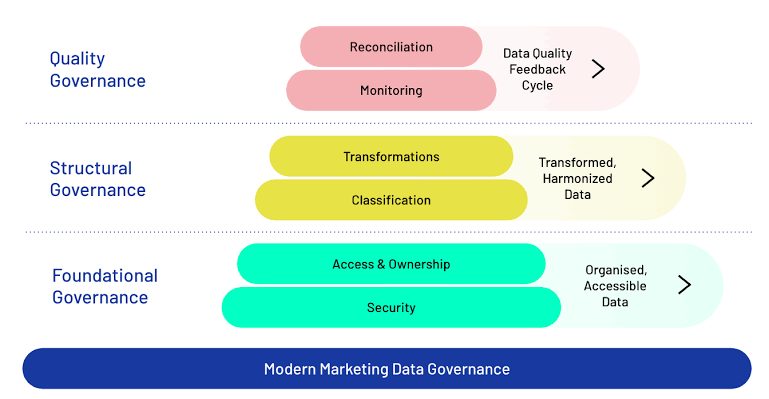
Let's look at how this loop functions in a real-world enterprise scenario involving something as simple as a customer onboarding process:- Governance Sets the Benchmark: The Data Governance committee, including representatives from Sales, Finance, and IT, establishes a business rule: Every corporate client account must have a verified Tax Identification Number (TIN) and a standardized corporate address before a contract can be executed. The governance policy explicitly names the Finance Operations Manager as the “Data Owner” for client financial records.
- Quality Enforces and Monitors: The database engineering team takes that business rule and translates it into technical infrastructure. They build validation checks directly into the CRM application interface to prevent a salesperson from leaving the TIN field blank. They write automated profiling scripts in the SQL Server environment that scan the database every night, verifying that every new TIN matches the required numerical format and checking for potential duplicate accounts using fuzzy matching logic.
- The Loop Resolves the Exception: One morning, the data quality script flags a batch of twenty new client accounts that have identical TINs but slightly different variations of the same corporate name. Because a governance framework is in place, the system knows exactly what to do with this alert. It doesn’t just sit in an unread IT log file. The alert is automatically routed to the designated Data Steward for Finance Operations.
- Systemic Improvement: The Data Steward investigates and discovers that a newly acquired regional sales team is bypassing the CRM validation rules by entering a generic placeholder TIN whenever a client takes too long to provide their actual tax info.
Because there is a governance structure, the solution isn’t just to manually change those twenty records. The Data Steward conducts a mandatory training session for the new sales team, works with development to close the loophole in the software interface, and updates the intake process.
The data is cleaned, but more importantly, the system is fixed so that the error cannot happen again. That is the power of the loop. Data quality identifies the fire, but data governance is what rewires the house to prevent future short circuits.
5. The Competitive Value of Data Discipline
When you step back from the technical jargon and the organizational charts, the reality of data management comes down to a simple truth: trust is your most valuable infrastructure asset.
If your data layer is built on a weak foundation, the cost to your business is immense. Data scientists spend 80% of their time cleaning data rather than analyzing it. Managers rely on gut instinct rather than reports because they secretly know the dashboard numbers are shaky. IT teams spend their weekends firefighting data corruption issues and system sync failures instead of building new features that drive business growth.
Conversely, an organization that masters both data quality and data governance operates with incredible speed and clarity. When a dashboard says customer churn increased by 4% in a specific market, leadership doesn’t waste two weeks arguing over whether the report is accurate. They trust the data implicitly, identify the root cause immediately, and pivot their strategy ahead of the competition.
6. Building Your Implementation Roadmap
If your organization realizes its data strategy is currently out of balance, you don’t need to tear down your entire technology stack and start over. You simply need to bring these two forces into alignment.
Step 1: Audit Your Current Footprint
Look honestly at your existing operation. Do you have a mountain of unenforced policy documents sitting on a corporate intranet drive? If so, you are heavy on governance and light on quality. Do you have developers constantly writing manual patch scripts to fix broken data tables every week? If so, you are relying entirely on data quality fire fighting without a governance framework.
Step 2: Empower Data Stewards with Technical Tools
Don’t turn data governance into an abstract talking shop. Identify the people who are closest to the business logic in each department and officially designate them as Data Stewards. Then, give them the automated data profiling and monitoring tools they need to see the health of their data in real time.
Step 3: Optimize the Intake, Don’t Just Clean the Storage
Shift your data quality efforts as close to the point of origin as possible. It is infinitely cheaper and more efficient to prevent a bad piece of data from entering your database via strict interface validation and schema constraints than it is to hunt down and fix that bad record inside a data warehouse three months later.
At Falcon Source, we see this interplay play out across complex enterprise environments every day. We believe that database performance, operational stability, and strategic clarity are all downstream from disciplined data management. We don’t just look at a database as a collection of isolated tables and queries; we look at it as a living system that requires both precise engineering (Quality) and structural integrity (Governance) to thrive.
Whether your business needs to optimize a struggling SQL Server environment, clean up fragmented legacy data pipelines, or design a governance framework that actually works for your people rather than slowing them down, the goal is always the same: turning your data into an asset you can confidently bet the future of your business on.
Is your data foundation showing signs of stress? Stop wasting internal resources on endless, manual data cleanup cycles. At Falcon Source, we bring over fifteen years of deep database expertise to help enterprises build clean, high-performance, and resilient data environments. Contact Falcon Source today for expert help with data governance, data quality, SQL Server, Power BI, and enterprise data management.